Coding for Nigerian Secondary Schools
Education, Coding for Secondary Schools Nigeria
From Players to Creators: How Nigerian Secondary Students Are Learning to Code
In Chidi’s words, coding used to be “foreign magic”. As a JSS1 student in Enugu, his experience with technology was limited to playing football games on his cousin’s phone and watching YouTube highlights when data allowed. Then, during his first Digital Technologies practical, his teacher opened Scratch, drew a ball, and said, “In 45 minutes, you will make this ball bounce by yourself.”
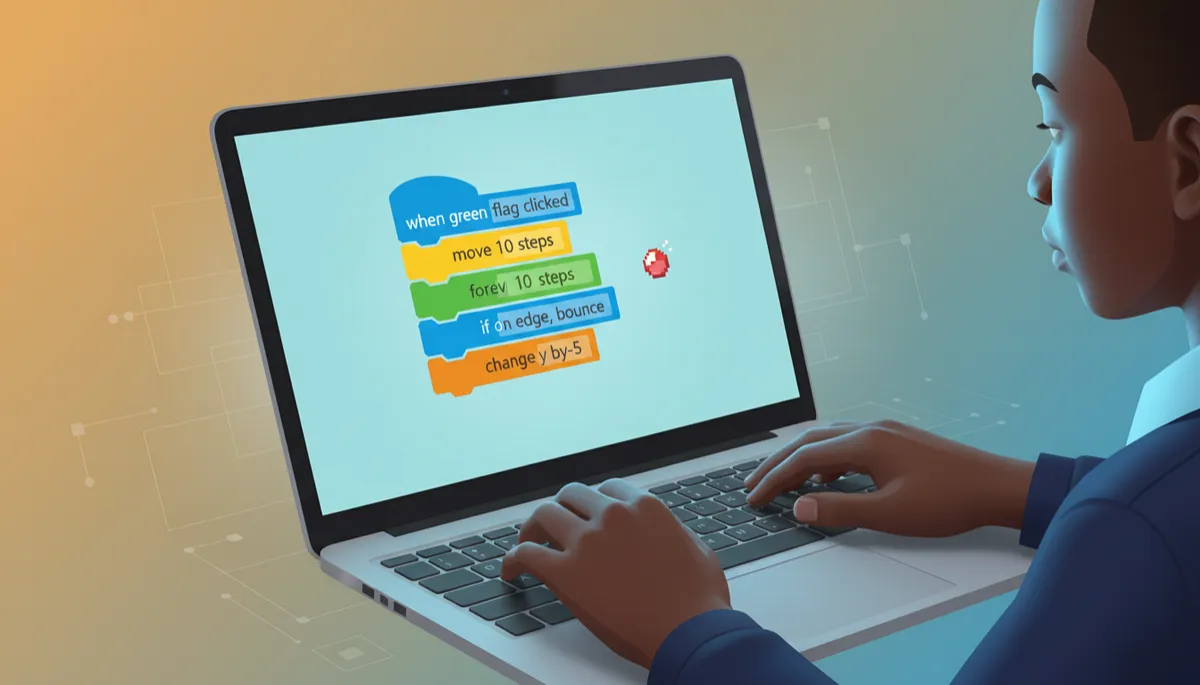
By the end of that single lesson, Chidi had dragged a few colorful blocks together: when green flag clicked, forever, if on edge, bounce. The ball started bouncing around the screen, and the whole class shouted. In that moment, coding stopped being magic and became something he could control. That is the shift we want to see across coding for secondary schools Nigeria.
From Tech Consumers to Tech Builders: Changing the Mindset
As a senior software engineer who has mentored many Nigerian interns, I see the same pattern repeatedly: students are brilliant at using apps, but hesitant about building them. They assume real software is created somewhere overseas, by people with better accents and better laptops. School is where that mindset must change, especially now that Digital Technologies (DGT) is a core subject from JSS1 to SSS3 under the updated NERDC curriculum (learnstack.ng).
The fastest way to move students from “I use tech” to “I build tech” is to let them see something they created come alive in one lesson. That’s why starting with Scratch programming Nigeria is so powerful. Instead of beginning with theory, syntax, or definitions, you start with:
A bouncing ball game (like Chidi’s)
A quiz that speaks in Pidgin or a local language when you get answers right
A simple story animation about life in their own community
When students see characters wearing Ankara, speaking like them, and responding to their code, they realize: “This thing is for me.” That is the heart of effective coding for secondary schools Nigeria; local, visible, and hands-on from day one.
💡 Pro Tip for School Heads: In your first term, measure success not by how many definitions students can recite, but by how many students can proudly demo a small project they built themselves.
A Practical Progression: From Scratch Blocks to Python and HTML
One of the biggest questions I hear from school administrators is: “How do we teach coding JSS1 SS3 without confusing students or overwhelming teachers?” The answer is to treat coding like Mathematics: you don’t start with calculus; you start with counting, then addition, then multiplication. In programming, the same idea applies.
JSS1–JSS2: Block-Based Logic with Scratch
At this stage, the goal is to build computational thinking, not syntax. Students learn:
Sequencing (what happens first, next, last)
Loops (repeat actions)
Conditions (if something happens, do this)
Events (when key pressed, when sprite clicked)
For Chidi’s bouncing ball, the Scratch blocks are visual, but the logic is the same as “real” code. Later, when he sees while True: in Python, it will feel familiar.
JSS3–SS1: Bridging to Text with HTML and Introductory Python
Once students are comfortable with Scratch, we introduce the idea that “these blocks are just a friendly way of writing instructions.” Now we can move into simple, visual HTML and beginner-friendly Python for Nigerian students.
A first HTML exercise might be a personal profile page:
<!DOCTYPE html>
<html>
  <head>
    <title>Chidi's Page</title>
  </head>
  <body>
    <h1>Hello, my name is Chidi</h1>
    <p>I am 12 years old and I love football.</p>
  </body>
</html>
Suddenly, they see their own name on a web page. Again, we reinforce the idea: coding is not foreign; it is personal and local.
SS2–SS3: Problem-Solving with Python
By senior secondary, students are ready for more structured Python for Nigerian students aligned with national initiatives like the Tech Terminal National ICT Programme (tecterminal.com). Here we move from games to solving simple, real problems:
# Simple transport fare calculator for Lagos students
distance_km = float(input("Enter distance from home to school (km): "))
fare_per_km = 150

total_fare = distance_km * fare_per_km

print("You will spend", total_fare, "naira per trip.")
When a student uses code to calculate their actual daily transport cost, the subject stops being abstract and becomes a tool for everyday reasoning.
Teaching Coding in Low-Bandwidth and Offline Nigerian Classrooms
Many schools hesitate to launch coding because they assume they need constant high-speed internet. In reality, most of the foundational work for coding for secondary schools Nigeria can be done offline, even with modest equipment and unreliable power, challenges that research continues to highlight across the country (arxiv.org).
Offline Scratch: Install the Scratch Desktop app on lab computers once. Students can build games, animations, and interactive stories without internet access.
Local servers or shared folders: A single “teacher laptop” can store project templates and example files, shared via USB or a simple local network.
Text editors over heavy IDEs: For Python and HTML, use lightweight tools like Notepad++, VS Code (installed once), or even the default text editor. No internet needed to run basic scripts.
Printed “code cards”: For very large classes or limited devices, teachers can print small code snippets and have students trace logic on paper before touching the computer.
⚠️ Reality Check: Unstable power and bandwidth are real, but they are not reasons to delay coding. Start with what you have; optimise later with solar, battery backups, or partnerships.
Real-World Project Frameworks from JSS1 to SSS3
To truly teach coding JSS1 SS3, you need a clear progression of projects that match students’ maturity and the national Digital Technologies scheme of work. Here is a practical framework you can adapt.
JSS1: “I Can Make Things Move”
Flagship project: Bouncing ball or simple maze game in Scratch.
Focus concepts: Events, motion, simple loops, basic debugging (“Why is my ball stuck?”).
JSS2: “I Can Control Stories and Decisions”
Flagship project: Interactive story about a local issue (e.g., keeping the environment clean) where the user chooses what happens next.
Focus concepts: Variables (score, health), conditionals, multiple scenes.
JSS3: “I Can Present Myself Online”
Flagship project: Personal profile website using HTML and simple CSS no hosting required; students view via browser locally.
Focus concepts: HTML structure, headings, paragraphs, lists, images.
SS1: “I Can Work with Data”
Flagship project: Python program that stores and analyses simple class data; like test scores or daily temperatures.
Focus concepts: Variables, lists, loops, basic input/output.
scores = [65, 70, 80, 90, 55]

total = 0
for score in scores:
    total = total + score

average = total / len(scores)

print("Class average is", average)
SS2–SS3: “I Can Solve Real Problems”
Flagship projects:
Budget calculator for a family or school club (Python)
Multi-page website about a social issue the students care about (HTML/CSS/very light JavaScript)
By SS3, a student like Chidi should be able to look back and see a journey: from a bouncing ball in JSS1 to a simple but meaningful application or website in SS3. That is what prepares them to thrive in university, bootcamps, or direct-entry tech roles in Nigeria’s growing digital economy (education.gov.ng).
Your Next Step as a School Leader
Chidi’s 45-minute bouncing-ball game is not a miracle story. It is what happens when a school has a clear, age-appropriate plan to teach coding JSS1 SS3, aligned with the national Digital Technologies curriculum and grounded in the realities of Nigerian classrooms; limited bandwidth, mixed-ability learners, and tight timetables.
With the right scheme of work, teachers don’t have to be professional software engineers to deliver impact. They need structured lesson plans, offline-friendly tools, and project ideas that make sense in our context. That is exactly what a well-designed, NERDC-aligned coding curriculum provides.
If you are serious about transforming your students from tech consumers to tech builders without guessing, patching together YouTube videos, or overloading your teachers now is the time to act.
Discover NDI’s NERDC-aligned Digital Technology and Coding Curriculum and see how your school can take students from their first Scratch project in JSS1 to confident Python and web developers by SSS3.
