Digital Tech Education in Nigeria: A Student's Journey
Education, Digital Technology, Nigeria
Beyond the Chalkboard: What Digital Technology Education Really Means for Nigerian Students
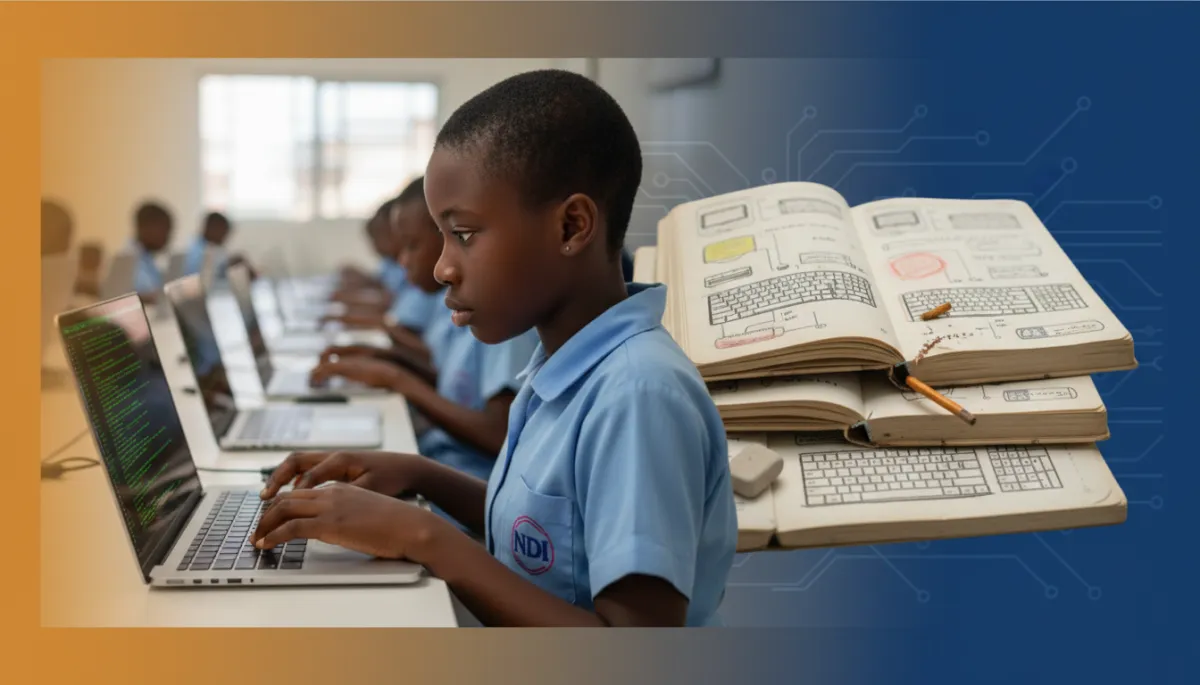
For three full terms in JSS2, Priye’s computer lived only in her exercise book. In a crowded classroom in Port Harcourt, her teacher carefully drew a keyboard on the chalkboard. The class copied every key into their notebooks: Q–W–E–R–T–Y in perfect rows, arrows neatly shaded, spacebar underlined twice. Yet not one child in that room touched an actual computer all term.
The “Notebook Computer” Reality in Many Nigerian Classrooms
Priye’s story is painfully familiar across Nigeria. In too many schools, digital technology education Nigeria still means:
Copying diagrams of keyboards, monitors, and system units into notebooks
Memorizing definitions of hardware and software for tests
Preparing for exams instead of preparing for real digital life
This “Notebook Computer” approach is not what the modern NERDC digital technology curriculum was designed for. Since the 2025-2026 reforms, NERDC has positioned Digital Technology and Digital Technologies as core, skill-based subjects from JSS1 to SSS3, with clear pathways into coding, data, cybersecurity, and emerging technologies. Yet a gap remains between the curriculum on paper and what learners like Priye actually experience in class.
From Chalkboard Keyboard to First Line of Code: Priye’s Turning Point
Everything changed the day Priye walked into an NDI-supported digital lab in the Niger Delta. Instead of chalk dust and faded diagrams, she met rows of working laptops, reliable power, and a facilitator who began with a simple sentence: “Today, you will write your first line of code.”
Her hands shook as she placed her fingers on a real keyboard for the first time. The keys she had drawn for months were suddenly under her fingertips. Instead of tracing letters in a notebook, she typed: print("Hello, Priye"). When the words appeared on screen, the classroom erupted. For the first time, “computer” was not a picture. It was a tool she could control.
What True NERDC-Aligned Digital Technology Education Looks Like
The revised NERDC scheme for JSS and SSS goes far beyond drawing devices. By 2026, students are expected to:
Use spreadsheets to analyze data and create charts from real information
Build simple websites, mobile apps, and interactive presentations
Learn programming fundamentals, AI basics, cybersecurity, and digital rights
In other words, digital technology education Nigeria is meant to be hands-on, project-based, and future-focused. When schools implement the curriculum as intended, a student like Priye should progress from basic digital literacy in JSS1 to building real tech solutions by SSS3.
Four Pillars of Modern Digital Technology Education
1. Coding: From Consumers to Creators
Coding is at the heart of the new Digital Technologies pathway. In Priye’s NDI lab, coding began with simple text-based tasks: printing messages, doing basic calculations, and building tiny quizzes. Over time, these skills can grow into web design, app development, and even basic AI projects, exactly as outlined in the senior secondary scheme of work.
2. Digital Literacy: Safe, Smart, and Responsible Online
True ICT in Nigerian schools is more than learning how to open a document. It includes understanding online safety, digital footprints, cyberbullying, and how to judge if information is reliable. In NDI-supported sessions, Priye learned why she should not share personal details online, how to recognize suspicious links, and how digital laws protect her rights as a learner.
3. Data: Turning Numbers into Decisions
The NERDC curriculum introduces data early: from simple tables and charts in JSS to data science basics in SSS. In one project, Priye’s class collected data on how many minutes students spend walking to school. They entered the figures into a spreadsheet, created bar charts, and discussed which areas might benefit most from a school bus. Data stopped being “something in the exam syllabus” and became a way to solve problems in her own community.
4. Hardware Fundamentals: From Labels to Hands-On Repairs
Instead of only labelling “CPU” and “monitor” in a diagram, modern digital technology education lets learners open up real devices (safely), identify components, and understand how they work together. In the NDI lab, Priye watched a facilitator replace a laptop RAM stick and then helped clean a dusty keyboard. She saw how poor maintenance can kill a lab, one of the biggest reasons many donated ICT centers fail within two years.
How NDI Bridges Curriculum and Classroom Reality
Across the Niger Delta, digital education Niger Delta faces familiar barriers: unstable power, limited devices, and teachers who were never trained on the new NERDC expectations. This is where NDI steps in, not to replace the curriculum, but to activate it.
Infrastructure that works: NDI-supported labs provide reliable devices, backup power, and maintenance plans so computers remain functional beyond the first year.
Teacher support: Facilitators co-teach with school staff, modelling how to deliver coding, data, and hardware lessons aligned with the NERDC digital technology curriculum.
Real projects, not just theory: Students build small apps, websites, and data projects that reflect their local context, turning static topics into living experiences.
📌 Key Takeaway: NERDC has already defined what 21st-century digital skills should look like. The real challenge is implementation. NDI’s model shows how to move from curriculum documents to working labs, confident teachers, and students who can actually code.
From Priye to a Generation: What’s at Stake for Nigerian Schools
National strategies from the National EdTech Strategy to the Digital Learning Policy are clear: Nigeria wants every child to be digitally literate by 2030. But that vision will not be met with chalk-drawn keyboards and theoretical ICT notes alone. It will be achieved when thousands of students like Priye move from copying technology to creating with it.
For school owners and administrators, the question is no longer “Should we teach ICT?” but “Are we teaching ICT the way NERDC intended and the way our students deserve?” That means working labs, trained teachers, and partners who understand both policy and practice on the ground in Nigeria.
Ready to Move Beyond the Chalkboard?
Priye’s journey from drawing keyboards in a notebook to writing real code in an NDI-supported lab does not have to be the exception. It can be the new normal for digital technology education Nigeria-wide, especially in regions that have been left behind.
Want to upgrade your school’s ICT curriculum? [Partner with NDI Today]
