
Empowering Teachers: Transforming Tech Education
Education, Teacher Training, Technology, Nigeria
Unlocking the Lab: How Empowering Teachers Transforms Technology Education
In many Nigerian schools, the story of technology is written not in lines of code, but in layers of dust on locked computer lab doors. This is the story of how one teacher, Mr. Okon, moved from fear to confidence, and how practical focused teacher training turned an underused lab into a vibrant hub of STEM learning.
From Intimidated to Inspired: Meet Mr. Okon
For 15 years, Mr. Okon has been a dedicated science teacher in a public secondary school on the outskirts of Port Harcourt. His students know him for his chalkboard diagrams of the human heart, his improvised experiments using plastic bottles and candles, and his constant refrain: “Science is life.” Yet, when the school received a brand-new computer lab through a government intervention project, he felt something he rarely admitted, fear.
The lab arrived with fanfare: shiny desktops, new furniture, and a plaque on the wall. But after the commissioning ceremony ended, the lab stayed mostly locked. The reasons sounded familiar: “We don’t want the computers to spoil,” “There is no ICT teacher yet,” “The teachers are still learning.” For almost a year, students walked past the lab door like it was a museum exhibit, not a learning space. Inside, dust gathered quietly on expensive equipment meant to shape their future.
The Tragedy of Locked and Dusty Computer Labs
This is not just one school’s problem. Across Nigeria, and especially in the Niger Delta, there is a growing tragedy: expensive, locked, and dusty school computer labs. Donor agencies, government projects, and well-meaning community groups invest millions of naira in ICT infrastructure. Yet without intentional teacher training technology Nigeria programmes, these investments often fail to reach the classroom level where they matter most, during everyday lessons between teacher and student.
Hardware alone cannot transform learning. A lab without empowered teachers becomes a symbol of lost opportunity. It widens the gap between students in well-resourced private schools and those in public schools who only see computers through classroom posters or exam questions. The real difference is not the number of computers; it is the confidence, skills, and mindset of the teachers who use them.
📌 Key Takeaway: Technology hardware is only the first step; teacher capacity building is what truly unlocks the lab.
Tech Anxiety: The Silent Barrier for Veteran Educators
Like many veteran educators, tech anxiety held Mr. Okon back. He had built a successful career long before computers were common in classrooms. Chalk, notebooks, and his deep subject knowledge had carried generations of students to good results. The idea of logging in, clicking through unfamiliar menus, or accidentally “spoiling” a system felt risky and embarrassing.
This is the quiet reality behind many closed computer lab doors. Teachers worry that students will know more than they do. They fear making mistakes in front of a class. They are unsure where to start with ICT training for educators that respects their experience instead of making them feel obsolete. Without targeted support, even the most passionate teacher can end up avoiding the lab altogether.
💡 Pro Tip: The fastest way to overcome tech anxiety is guided, hands-on practice in a safe, non-judgmental environment, exactly what effective capacity building provides.
The 3-Day NDI Teacher Workshop That Changed Everything
Everything shifted when the school partnered with NDI to host a 3-day Teacher Technology Capacity Building Workshop. Designed specifically for schools in Rivers State and the wider Niger Delta, the programme focused on practical digital skills for teachers Port Harcourt and beyond no jargon, no intimidation, just real classroom applications.
On Day 1, teachers learned basic computer operations, file management, and internet use, but always tied to their subjects; science, mathematics, social studies, and more.
On Day 2, they explored digital lesson delivery, discovering how to turn chalkboard notes into simple slide presentations, interactive demonstrations, and multimedia explanations.
On Day 3, the focus moved to automated assessment and facilitation skills; how to use basic tools to create quizzes, track scores, and manage live computer-based activities with a whole class.
For the first time, someone was not just telling teachers to “use the lab”; they were showing them, step by step, how to make technology serve their existing strengths as educators. By the end of the workshop, the same teacher who hesitated to touch the mouse was confidently projecting a science diagram and asking students to come up and label it on screen.
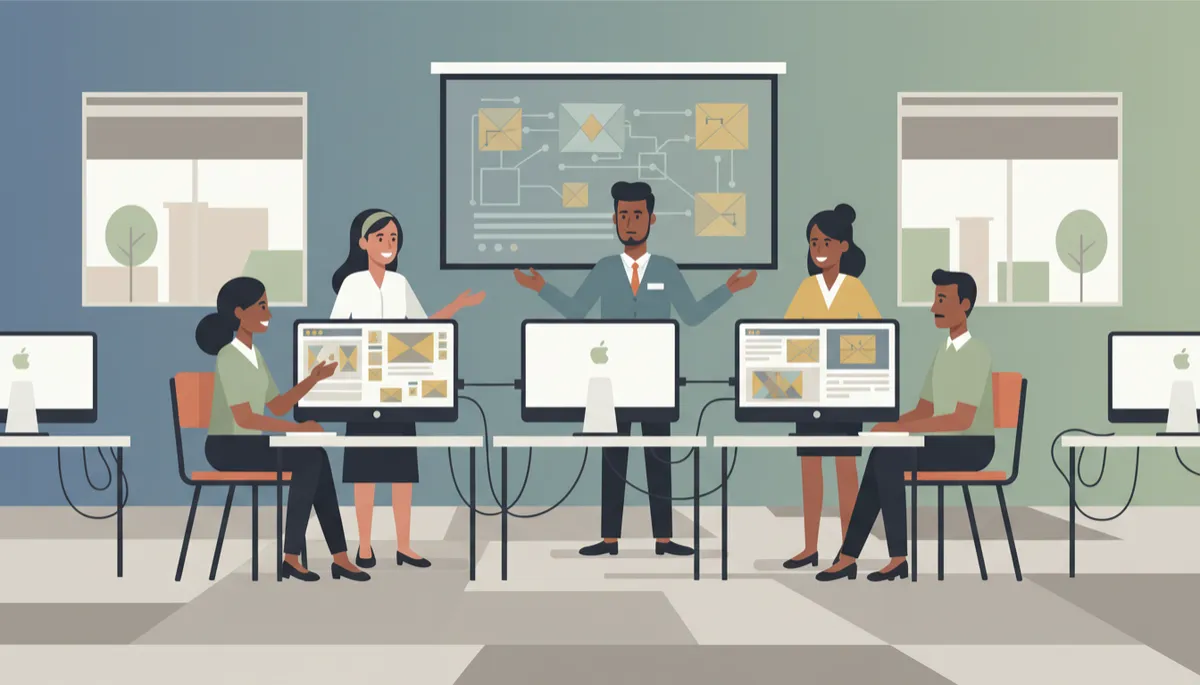
Hands-on NDI workshops turn hesitant teachers into confident classroom technology leaders.
Core Components of Effective Teacher Capacity Building
What made the NDI workshop so powerful for Mr. Okon and his colleagues? Beyond the friendly facilitators and practical pace, three core components stood out, elements that any serious capacity building Nigerian schools initiative must include.
1. Digital Lesson Delivery
Teachers learned how to move from handwritten notes to digital lesson delivery without losing their personal teaching style. For science, this meant embedding short animations to show particle motion or using images to compare plant and animal cells. For mathematics, it meant displaying step-by-step solutions clearly on screen. For English, it meant projecting passages and highlighting key sections as students read along.
Creating simple slide decks tailored to their scheme of work
Using projectors or shared screens so every student can see clearly
Integrating videos, diagrams, and charts to make abstract concepts concrete
2. Automated Assessment and Feedback
Marking scripts late into the night is a familiar struggle for Nigerian teachers. The workshop introduced automated assessment tools that allowed educators to create digital quizzes, objective tests, and short-answer exercises that could be graded instantly. This freed up valuable time for deeper feedback and lesson planning, while giving students faster insight into their performance.
Setting up simple multiple-choice tests that mark themselves
Exporting scores into basic spreadsheets for record-keeping and analysis
Using instant results to identify struggling students quickly and intervene
3. Facilitation in a Digital Classroom
Technology changes the flow of a lesson. Instead of standing alone at the front, teachers become facilitators; moving around the room, guiding students who are each working at a computer, and managing group activities. NDI’s trainers modeled how to:
Set clear rules for device use and online behavior
Give step-by-step instructions so no student is left behind
Use questioning techniques and peer support to keep students engaged
For Mr. Okon, this was a revelation. He realised he did not need to be a “computer expert” before entering the lab. He simply needed a clear plan, basic tools, and the confidence to lead learning in a new environment.
NDI’s Impact Across Rivers State and the Niger Delta
NDI’s work with Mr. Okon’s school is part of a broader commitment to teacher training technology Nigeria, especially in underserved communities. Through targeted ICT training for educators, NDI has supported schools across Rivers State and the wider Niger Delta to turn dormant labs into active learning centres.
In Port Harcourt, Bonny, Ahoada, and other communities, NDI’s digital skills for teachers Port Harcourt initiatives have equipped hundreds of educators with practical competencies, from basic computer literacy to lesson design and digital assessment. Schools that once kept labs locked now schedule regular ICT periods, integrate technology into core subjects, and prepare students more effectively for computer-based examinations and a digital future.
Most importantly, the mindset is shifting. Teachers who once saw technology as a threat now see it as a partner. They share resources with colleagues, mentor younger staff, and advocate for better connectivity and maintenance. In many schools, people now refer to Mr. Okon as the STEM champion, the teacher who leads students into the lab with energy, not fear.
“Before, I used to pass the lab and look away. Now, my students remind me, ‘Sir, we have computer today!’ and I am happy to open that door.” — Mr. Okon
From Locked Doors to Open Futures: Your Next Step
The transformation of Mr. Okon’s school did not start with new computers they were already there, gathering dust. It started when someone invested in the people who stand between those machines and the students: the teachers. When educators are empowered, technology stops being a decoration and becomes a driver of real learning.
If your school, organization, or community has a computer lab that is underused, or if your teachers are eager but unsure where to begin, now is the time to act. With the right capacity building Nigerian schools programme, those locked doors can open, not just to a room full of devices but to a future where every student gains the digital skills they need to thrive.
Don’t let your lab become another dusty statistic. Enquire about NDI's Teacher Technology Capacity Building Programme today and equip your teachers to turn technology into a powerful tool for learning across Rivers State and the Niger Delta.
